
How Operating Companies Can Defend Against Rising Electricity Bills
Electricity has become a strategic operating cost, not simply a facilities expense. Today,, industrial and commercial businesses are facing a combination of:
- Higher energy demand
- Volatile pricing
- Aging equipment
- Capacity constraints
- Sustainability expectations
- Pressure to protect margins
At the same time, the International Energy Agency expects global electricity demand to continue increasing as economies electrify, while energy-efficiency progress remains comparatively weak.
For this reason, for operating companies, the most reliable way to defend against rising electricity bills is to reduce the amount of electricity required to operate the business. Energy efficiency does not eliminate exposure to market prices, but it reduces the company’s consumption baseline, lowers demand, improves operating margins, and creates a partial hedge against future rate increases.
To help address these challenges, Lumen Global (“LG”) helps organizations identify, finance, and implement practical energy-efficiency measures across industrial, commercial, warehouse, logistics, and multi-site facilities. These projects can include LED lighting and controls, energy monitoring, compressed-air improvements, HVAC optimization, motor and fan efficiency, operating-procedure changes, and other measures that reduce kilowatt-hour consumption without disrupting the core business.
In addition, LG’s model is designed for businesses that need measurable savings but may not have the capital, internal resources, or management bandwidth to execute a comprehensive energy program. Through LumenSmart™, LG can install monitoring equipment to establish a facility-level consumption baseline, identify waste, and continuously analyze usage to uncover further savings. LG reports typical electric-bill savings of 10% to 30%, and sometimes more, depending on the facility and recommended strategies.
The result is a financially practical form of decarbonization: lower electricity consumption, lower operating costs, increased EBITDA, and reduced Scope 2 greenhouse-gas emissions.
The Operating Challenge
Electricity bills are driven by more than the posted energy rate. A company’s total bill may include:
- Energy consumption charges based on kWh used.
- Demand charges based on peak usage.
- Time-of-use pricing.
- Capacity, transmission, distribution, and other utility charges.
- Taxes, riders, and regulatory adjustments.
- Exposure to changing supply contracts or market prices..
Understanding What Drives Electricity Costs
An operating company cannot control every component of its electricity bill. It can, however, directly influence how much electricity its buildings and equipment consume, when that electricity is consumed, and how efficiently the facility responds to operating requirements.
That distinction is important. Negotiating a lower rate may provide a short-term benefit, but the company remains exposed to future increases and continues to consume the same amount of electricity. Efficiency creates a more durable benefit by reducing the underlying volume of energy required to produce, store, move, or sell goods.
Why Energy Efficiency Creates a Consumption Hedge
For a company spending $1 million annually on electricity, a 15% reduction in consumption and related charges could represent approximately $150,000 in annual savings before considering additional demand-charge benefits. If electricity prices increase by 20%, the same efficiency project provides an even more valuable buffer because the company is applying the higher rate to a smaller consumption base.
Energy efficiency therefore functions as a consumption hedge:
- Reducing the number of kWh purchased.
- Lowering peak demand where controls and equipment improvements are properly designed.
- Reducing exposure to future price increases.
- Improving cash flow without requiring a corresponding increase in sales.
- Reducing emissions associated with purchased electricity.
Where Energy Waste Hides
Industrial facilities often contain multiple layers of energy waste accumulated over years of expansion, acquisitions, equipment replacement, and changing operating patterns. The largest opportunities are not always found in the most obvious places.
Lighting and controls
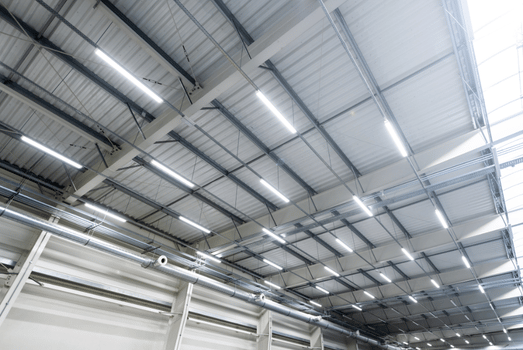
Lighting is often one of the fastest opportunities to address because industrial buildings frequently contain high-bay fixtures, fluorescent systems, outdated metal-halide lighting, exterior lighting, parking-lot lighting, emergency lighting, and fixtures that operate continuously regardless of occupancy.
For example, an effective lighting program can include:
- LED fixture replacement.
- Occupancy and motion sensors.
- Daylight harvesting.
- Scheduling and zoning.
- Dimming controls.
- Exterior-lighting optimization.
- Improved fixture placement.
- Reduced maintenance and replacement costs.
- Better visibility and workplace safety.
In addition, lighting projects reduce electricity use directly and may also reduce cooling loads because efficient fixtures produce less heat. Beyond the utility bill, in warehouses and industrial buildings, the operational benefits can extend to improved illumination, safety, product visibility, quality control, employee experience, and facility presentation.
Compressed air
Similarly, compressed air is one of the most commonly overlooked sources of industrial energy waste. Leaks, excessive system pressure, inappropriate uses, poor compressor sequencing, and inadequate maintenance can cause compressors to operate far beyond what production requires.
To address these issues, practical measures include:
- Leak detection and repair.
- Lowering system pressure where appropriate.
- Eliminating inappropriate uses of compressed air.
- Optimizing compressor sequencing.
- Improving storage and distribution.
- Replacing inefficient controls.
- Matching compressor output to actual demand.
- Establishing an ongoing leak-management program.
The U.S. Department of Energy identifies compressed air, motors, pumps, fans, process heating, steam, and lighting as important industrial efficiency opportunities. Its industrial assessment tools are specifically designed to quantify savings from measures such as reducing compressed-air pressure, upgrading lighting, and improving motor-driven systems.
Motors, fans, pumps, and drives
Another significant opportunity involves motor-driven systems, which are often responsible for a significant share of industrial electricity consumption. Oversized motors, throttled pumps, inefficient fans, worn belts, poor alignment, and equipment operating at full speed when demand varies can all create unnecessary consumption.
Potential measures include:
- Premium-efficiency motors.
- Variable-frequency drives.
- Variable-speed electronically commutated fans.
- Pump impeller trimming.
- Improved system balancing.
- Correct motor sizing.
- Belt replacement and alignment.
- Equipment scheduling and shutdown controls.
- Preventive maintenance based on operating data.
According to the Department of Energy, industrial plants can often reduce electricity use in motor-driven systems by approximately 5% to 15% or more through efficiency improvements and best-practice measures.
HVAC, ventilation, and building controls
Industrial facilities frequently contain large spaces that are heated, cooled, ventilated, or conditioned beyond what is necessary for the people, products, and processes inside them.
Efficiency opportunities may include:
- HVAC scheduling.
- Temperature and setpoint optimization.
- Variable-speed drives.
- High-efficiency heating and cooling equipment.
- Economizer controls.
- Building-management-system upgrades.
- Airflow balancing.
- Improved filtration and maintenance.
- Zoning based on occupancy and process requirements.
- Heat recovery.
- Dock-door and building-envelope improvements.
Building controls are particularly valuable because they convert a facility from a static operating model into a responsive system. Instead of running equipment continuously, controls can adjust operations based on occupancy, temperature, production schedules, ambient conditions, and actual demand.
Monitoring and operating behavior
A facility cannot consistently manage what it cannot see. Many businesses receive a monthly bill but lack the interval-level data needed to understand when energy is being consumed, where peaks occur, or which equipment is responsible for abnormal usage.
To provide this visibility, LumenSmart™ uses sensors attached to facility electrical feeds for specific operating equipment/systems to transmit consumption data to a cloud-based platform. LG establishes a baseline, analyzes patterns, identifies waste, and monitors changes over time.
As a result, the system is designed to detect increases in energy use so corrective action can be taken before higher consumption becomes a permanent cost.
Monitoring can reveal:
- Equipment operating outside production hours.
- Unexplained overnight and weekend consumption.
- Peak-demand events.
- Sudden increases caused by failing equipment.
- Simultaneous heating and cooling.
- Compressed-air systems running during idle periods.
- Lighting left on in unoccupied areas.
- Differences in performance between locations.
- Energy intensity changes relative to production or occupancy.
The value is not simply the data. The value is using the data to make operational decisions and sustain the savings after the initial project is complete.

Lumen Global Case Studies
LG’s experience demonstrates how energy efficiency can create both operating savings and enterprise value.
Industrial printing company: EBITDA and enterprise-value impact
LG conducted an energy-usage audit for a private-equity-backed industrial printing company. The audit identified losses associated with inefficient lightbulbs, poor lightbulb placement, compressed-air system leakage, and suboptimal operating procedures. The findings and savings plan were presented to senior management, approved, and implemented across facilities in the United States and the United Kingdom.
The project added USD 1.3 million to EBITDA. Based on an assumed 12.6x to 17.3x EV/EBITDA multiple range, LG estimates that the EBITDA improvement represented approximately USD 16.4 million to USD 22.6 million in potential enterprise value.
This example illustrates why energy efficiency should be evaluated as a value-creation initiative rather than simply a maintenance project. A recurring reduction in operating costs can improve cash flow, margins, debt capacity, valuation, and exit positioning.
240,000-square-foot warehouse: savings, return, and safety
Similarly, LG worked with the owner of a 240,000-square-foot warehouse to implement an energy-efficiency project. The project achieved projected lifetime savings of more than $600,000 and a project-level internal rate of return of 70%. Additionally, it created a safer work environment through improved lighting.
In particular, large warehouses are well suited to lighting and controls programs because they often have:
- High ceilings and high-bay fixtures.
- Long operating hours.
- Significant square footage.
- Areas that are intermittently occupied.
- Exterior and loading-dock lighting.
- Lighting systems that have not been comprehensively upgraded.
The project demonstrates that energy efficiency can simultaneously address financial performance, facility quality, employee safety, and sustainability objectives.
National restaurant franchise: high-return lighting conversion
For a major national restaurant franchise, LG converted kitchen areas and parking lots to LED. The project achieved a projected lifetime savings of $274,000 and an internal rate of return of 105%. The client also reported improved employee satisfaction and a significant improvement in store presentation.
Although the operating environment differs from an industrial plant, the principle is transferable to multi-site portfolio companies: standardized energy projects can be replicated across locations, creating a larger cumulative impact while maintaining consistent implementation standards.
LumenSmart industrial monitoring: identifying hidden consumption
Beyond individual efficiency projects, LG’s monitoring model is designed to find savings that may not be visible from a utility bill or a one-time walkthrough. By collecting data at frequent intervals, LG can identify baseline consumption, irregular patterns, and changes in energy intensity.
Furthermore, LG reports typical electric-bill savings of 10% to 30%, and sometimes more, depending on the recommended strategies. Clients pay a modest monthly fee for the installation and materials required to begin monitoring under the LumenSmart model.
Importantly, the monitoring layer is especially valuable after an initial retrofit. It helps confirm that expected savings are occurring, identifies operational drift, and creates an early-warning system when energy consumption begins to rise.
Energy Efficiency as GHG Reduction
Reducing electricity consumption generally reduces Scope 2 emissions associated with purchased electricity. The emissions benefit depends on the electricity source and the applicable reporting method.
The basic calculation is:
Avoided emissions=Avoided kWhGrid emissions factor
For example, if an industrial site reduces consumption by 500,000 kWh annually and the applicable grid emissions factor is 0.35 kilograms of CO₂e per kWh:
500,000×0.35=175,000 kg CO₂e
That equals approximately 175 metric tonnes of avoided CO₂e (MTCO2e) per year.
Portfolio-Level Emissions Reduction
However, the actual emissions result will vary by jurisdiction, utility mix, and reporting methodology. Location-based reporting reflects the average emissions intensity of the electricity grid, while market-based reporting may reflect contractual instruments such as renewable-energy purchases. Efficiency remains valuable under both approaches because it reduces physical electricity demand and can lower operating exposure before renewable procurement is considered.
A Practical Lumen Global Program
LG’s approach is designed to move from opportunity identification to implementation and ongoing performance management.
1. Portfolio and facility screening
First, LG begins by identifying businesses and locations with the greatest potential based on:
- Square footage.
- Number of facilities.
- Operating hours.
- Utility spend.
- Industrial processes.
- High-bay or exterior lighting.
- Compressed-air systems.
- HVAC and ventilation requirements.
- Multiple utility accounts.
- Significant peak demand.
- Limited internal CAPEX availability.
The strongest candidates are often industrial, logistics, manufacturing, distribution, food processing, printing, and other businesses operating large or multiple facilities.
2. Baseline and energy audit
Next, LG reviews utility bills, facility characteristics, operating patterns, equipment, and available interval data. The objective is to determine where electricity is being consumed and which projects can produce measurable savings.
The analysis should separate:
- Energy savings.
- Demand savings.
- Maintenance savings.
- Avoided replacement costs.
- Production or operational impacts.
- Emissions reductions.
- Implementation costs.
- Expected payback and return.
3. Project design and prioritization
Once opportunities are identified, projects are prioritized based on financial return, implementation complexity, operational risk, and strategic value. In many cases, a practical program may begin with quick wins and then move to more comprehensive measures.
Potential measures include:
- LED lighting and controls.
- Compressed-air leak repair.
- HVAC and ventilation optimization.
- Building-management systems.
- Motor and drive upgrades.
- Pump and fan optimization.
- Equipment scheduling.
- Energy monitoring.
- Process improvements.
- Demand-management controls.
4. Funding and implementation
At this stage, many operating companies face pressure to reduce or defer CAPEX, even when high-return projects are available. LG’s financing approach is designed to address that barrier by funding implementation and aligning repayment or economics with realized savings, depending on the project structure.
This is particularly relevant for PE-backed companies managing debt resets, constrained capital budgets, acquisition integration, or competing investment priorities. As a result, the goal is to allow the operating company to act on projects that improve cash flow without requiring a large upfront capital allocation.
5. Verification and continuous improvement
Finally, energy efficiency should not be treated as a one-time installation. LumenSmart monitoring can provide ongoing visibility into performance, detect changes in consumption, and identify additional opportunities after the initial work is complete.
A successful program should track:
- Baseline kWh consumption.
- Post-project kWh consumption.
- Peak demand.
- Utility cost.
- Savings by site.
- Savings by project.
- Avoided Scope 2 emissions.
- Maintenance impacts.
- Operational or safety benefits.
- Portfolio-wide results.

The Strategic Case for Action
Taken together, energy efficiency deserves attention because it improves several dimensions of operating-company performance at the same time.
It protects margins
Lorem ipsum dolor sit amet, consectetur adipiscing elit. Ut elit tellus, luctus nec ullamcorper mattis, pulvinar dapibus leo.
It creates EBITDA leverage
A recurring reduction in operating costs can have an outsized effect on EBITDA. The industrial printing case study demonstrates how energy and operational improvements can contribute to a material EBITDA result and potential enterprise-value creation.
It reduces CAPEX pressure
At the same time, when companies are restricting discretionary spending, high-return energy projects may remain unimplemented despite being economically attractive. A third-party funding model can convert an energy project from a deferred capital request into a cash-flow improvement initiative.
It reduces exposure to future electricity increases
Moreover, a business cannot predict every future utility rate, regulatory change, capacity charge, or market event. However, it can reduce the number of kWh it needs to buy. Therefore, lower consumption provides a degree of protection regardless of how the price per kWh changes.
It supports emissions goals
Energy efficiency is often one of the most immediate and measurable ways to reduce Scope 2 emissions. It can provide progress while longer-term strategies, such as renewable procurement, electrification, onsite generation, or process redesign are being evaluated.
It scales across a portfolio
A PE sponsor or multi-site operating company can apply a common screening and implementation framework across multiple locations. This allows the organization to:
- Aggregate energy spends.
- Standardize project evaluation.
- Prioritize the highest-consumption facilities.
- Compare performance across locations.
- Replicate successful projects.
- Build a portfolio-level emissions baseline.
- Track value creation centrally.
Conclusion
Rising electricity bills are not only a pricing problem. They are a consumption, operating-discipline, equipment, and capital-allocation problem. Companies that wait for utility rates to stabilize remain exposed to every future increase. In contrast, companies that reduce consumption lower their costs today and create a structural defense against tomorrow’s prices.
To address these challenges, LG Global provides a practical path forward. Its work combines facility audits, project implementation, energy monitoring, operational improvements, and financing solutions designed to make high-return efficiency projects easier to execute. Lumen’s case studies show that the opportunity can extend well beyond utility savings: energy-efficiency projects can improve EBITDA, increase enterprise value, improve workplace conditions, reduce emissions, and strengthen the operating company’s resilience.
As a result, for industrial and multi-site businesses, the question is no longer whether energy efficiency is worth considering. The more important question is how quickly the organization can identify the highest-value opportunities, fund them, implement them, and verify the results.
Ultimately, Lumen Global helps operating companies turn energy consumption into a controllable source of margin improvement, cash-flow protection, and emissions reduction.